The most interesting reaction to MicroDuck isn't:
"That's technically impressive."
It's:
"I want one."
I've seen enough of the early discussion around MicroDuck to think that reaction matters.
People talk about the price.
They talk about the open software.
They talk about reinforcement learning.
They talk about what the robot can do.
But a lot of the emotional reaction happens before any of that.
People see the little duck moving around and immediately like it.
I think there is a reason.
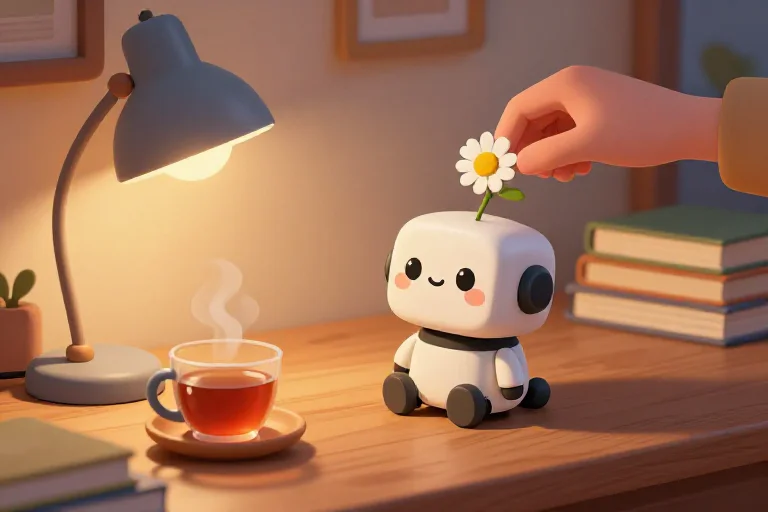
It looks like something you can care about
Most technology is visually neutral.
A phone is a phone.
A laptop is a laptop.
A speaker is a speaker.
They can be beautiful, but their shapes mostly tell you what they are.
MicroDuck is different.
It looks like a little creature.
That's enough to trigger a different reaction.
You don't look at it and think:
"Interesting hardware platform."
You think:
"Look at that little guy."
That's a powerful starting point.
Then it moves
This is where the emotional reaction gets stronger.
A cute figurine is cute.
A cute robot walking across the floor is something else.
Now the object has behavior.
It isn't just something you look at.
It is doing something.
MicroDuck can walk, roll, grasp, kick, and recover after falling. (Pollen Robotics)
None of those behaviors are revolutionary on their own.
Together, they make the robot feel much more alive than a static object.
Not alive in the literal sense.
Alive in the way we use the word when something has visible behavior that we naturally react to.
I don't think people are buying intelligence alone
This is where I think some descriptions of AI robots miss the consumer side.
People aren't necessarily thinking:
"I need an embodied large language model."
They are thinking:
"That thing is really cute."
Then:
"It can actually move?"
Then:
"Wait, it can grab things too?"
Then:
"Okay, that's really cool."
The emotional response comes first.
The technical explanation comes later.
That's why physical AI is different
AI inside a phone is invisible.
You use it.
You get an answer.
Then the experience disappears.
A physical robot stays in the room.
You know where it is.
You see it move.
That gives the intelligence a physical form.
And even if the robot is not doing anything useful at that exact moment, it is still there.
I think that's a big part of the attraction.
But I don't think cute is enough
This is the part I'm more cautious about.
Cute gets attention.
It doesn't guarantee attachment.
If MicroDuck were just a cute duck that could perform the same five-second routine forever, I think most people would eventually get tired of it.
The robot needs reasons to come back.
More play.
More interaction.
More personality.
More variety.
Maybe more usefulness.
That's where the product becomes harder.
The interesting thing about MicroDuck is that it has a little more depth underneath
Its software and training stack are openly published, and the robot's behaviors are based on learned policies rather than only traditional scripted animations. (Pollen Robotics)
That doesn't automatically solve the novelty problem.
But it gives the robot somewhere to go.
And I think that's important.
The first reaction might be:
"Cute."
The second:
"Fun."
The third:
"What else can it do?"
That third question is where a product either gets interesting or gets boring.
Maybe this is why the robot category feels different
A desktop robot isn't just another gadget.
At least, I don't think the most interesting ones are.
You aren't only buying functionality.
You're also buying a physical presence.
Something you can see.
Something that reacts.
Something that can become part of your space.
That is why people can get excited about a robot even before they know exactly what they would use it for.
They aren't only buying a tool.
They are buying the possibility of having a little character around.
And that's probably why I understand the "I want one" reaction
Because honestly, you don't need a perfect argument.
Sometimes the reason is just:
"That's adorable."
Then you look a little closer.
It moves.
It plays.
It interacts.
It is not just a picture on a screen.
And suddenly $399 doesn't sound completely ridiculous anymore.
I'm not saying everyone should buy one.
I'm saying the emotional reaction makes sense.
And I think understanding that reaction is probably more useful than pretending every robot purchase starts with a rational productivity calculation.
Sometimes the first reason you want a robot is simply:
you like the little thing.
The rest has to earn the purchase after that.
