Here's a question that desktop robots eventually have to answer:
Why not just use ChatGPT?
It's a fair question.
ChatGPT can already talk to you.
It can write.
It can see images.
It can remember context within supported experiences.
It can help you plan, research, learn, and work.
And it lives inside a device you already own.
So why put AI into a little robot?
I don't think the answer is that the robot makes AI smarter.
The answer is that it makes AI physical.
Your phone gave the internet a body
Think about what the smartphone did to the internet.
The internet already existed.
Information already existed.
Websites already existed.
But a smartphone made the internet something you carried around with you.
It changed where the internet could exist in your life.
Suddenly the internet wasn't only something you sat down at a computer to access.
It was with you.
I think physical AI may eventually have a similar transition.
AI already exists.
Models already exist.
Voice interfaces already exist.
Vision systems already exist.
But a physical robot can give those capabilities a body that occupies your space.
That is potentially a much bigger change than simply putting ChatGPT behind a different interface.
A robot has a place
This is one of the simplest differences.
When you talk to ChatGPT, you normally open a device.
When you interact with a robot, the robot is already there.
It might be sitting beside your keyboard.
It might be moving around your room.
It might be facing you.
You don't have to think of it as an application.
It has a physical location.
That sounds almost too obvious to matter.
But I think it matters a lot.
Presence is different from access
Your phone gives you access to AI.
A robot can give AI presence.
Those are different things.
Imagine ChatGPT reminding you:
"It's almost midnight. You should probably get some sleep."
That's useful.
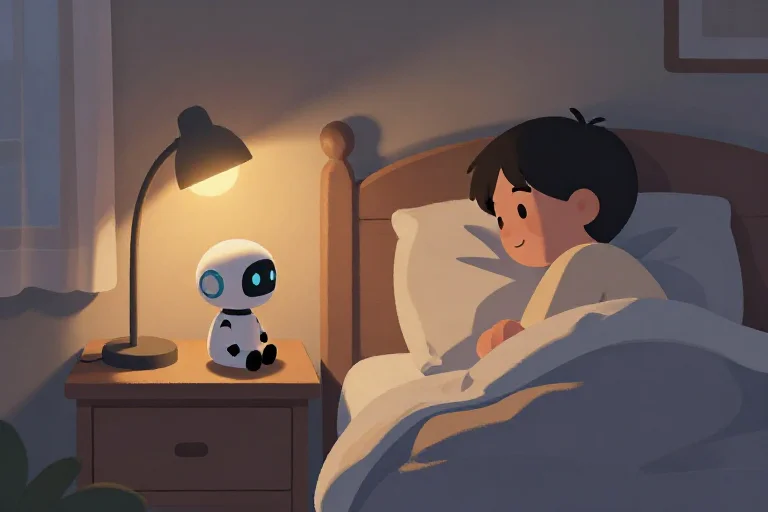
Now imagine a small robot sitting on your desk that starts giving you a familiar "go to bed" routine every night.
The underlying intelligence could be very similar.
The experience isn't.
The second one has a physical context.
You see it.
You hear it.
It becomes associated with a place and a routine.
It feels less like a notification and more like something interacting with you.
Whether that makes the experience better is personal.
But it is undeniably different.
Bodies give AI another way to communicate
AI usually communicates through:
- text
- images
- voice
A robot adds:
- movement
- orientation
- distance
- physical gestures
- physical interaction
A robot can look toward something.
It can move closer.
It can back away.
It can wave.
It can turn its head.
It can simply sit there.
Those behaviors don't contain much information by themselves.
But humans are very accustomed to reading physical behavior.
We don't only listen to what another person says.
We look at what they do.
A robot can participate in some of that same physical language.
This is where companion robots become interesting
Suppose you say:
"I'm having a terrible day."
A chatbot can respond with words.
A physical companion could eventually respond through words and behavior.
Maybe it comes closer.
Maybe it changes its expression.
Maybe it sits beside you.
Maybe it says nothing for a moment.
Maybe it knows that sometimes you don't want another paragraph of advice.
These are hypothetical examples, not features you should assume current desktop robots already provide.
But they show why physical AI is interesting.
The body creates another channel for interaction.
The body doesn't automatically create intelligence
There is an important warning here.
Putting an AI model into a robot does not magically make the robot intelligent.
You can put a language model inside a terrible interface.
You can put a great model behind a robot that has almost no useful physical capabilities.
You can give a robot a camera and still have no meaningful understanding of its environment.
The body is an interface.
The intelligence still matters.
The software still matters.
The interaction design still matters.
And the combination has to work.
That's why the software layer matters so much
A physical robot is expensive compared with an app.
You need motors.
Sensors.
Batteries.
Computing.
Manufacturing.
Shipping.
Maintenance.
The physical hardware is difficult.
But once the body exists, software can potentially change what that body is capable of doing.
A new behavior does not require manufacturing another robot.
A new personality does not require a new motor.
A better AI model does not require a new chassis.
That is why I find the software side of consumer robotics more interesting than the hardware specification alone.
The body is fixed.
The possibilities don't necessarily have to be.
And this is where ownership becomes interesting
Imagine two identical robots.
One belongs to you.
One belongs to me.
At first, they are almost the same.
Same hardware.
Same sensors.
Same basic capabilities.
But over time, ours could become different.
Different personalities.
Different memories.
Different routines.
Different behaviors.
Different skills.
Different relationships with their owners.
At some point, comparing them by hardware specifications stops telling the whole story.
One isn't simply:
"Robot model X."
It is:
"My robot."
That is a very different kind of consumer product.
The iPhone analogy is useful, but only up to a point
I think there is a useful analogy here.
The iPhone is not valuable because the physical phone itself can do everything.
Its value comes from the combination of:
hardware + operating system + apps + services + developers + user data.
A consumer robot could eventually work in a somewhat similar way.
The body provides the physical interface.
The operating layer provides intelligence and control.
Applications or skills add capabilities.
Different owners create different experiences.
But we're not there yet.
The robot ecosystem is still young.
And that is exactly why today's desktop robots are interesting.
They are early enough that you can still see the foundations being built.
So why does a robot feel different from ChatGPT?
Not because it necessarily knows more.
Not because it necessarily responds better.
And definitely not because every robot is already more useful.
It feels different because:
ChatGPT is something you access. A robot is something that exists with you.
That physical distinction may turn out to be extremely important for companion AI.
Maybe people don't always want another AI window.
Maybe they want something they can see sitting next to them.
Something that reacts.
Something that occupies a place.
Something that gradually becomes familiar.
Something they can call:
"mine."
That, to me, is the more interesting reason to put AI into a body.